2026 Evidence-Informed Guide to Post-Operative Soft-Tissue Recovery Support
If the Process Is Compliant, Why Does Post-Operative Support Still Require Repeated Checks and Handoffs?
Summary
Post-operative support most often loses continuity across professional boundaries, local feedback, and staff handovers. Standard pathways define restrictions, protection, and reviews, but do not automatically produce comparable local-response records between reviews. This guide provides an entry decision, a local-change pathway, randomized wIRA data, a four-step CYP8 process, and a request route for a practical review card.
1. What the Facility Is Actually Responsible for After Discharge
Evidence boundary: Published wIRA study observations are provided as technology-background context. They are not CYP8 brand-specific clinical evidence, treatment instructions, or a guarantee of wound healing, pain reduction, functional recovery, or any individual clinical outcome.
After discharge, the facility does not independently reassess the surgical result. Its role is to execute professional instructions consistently, record feedback, escalate abnormalities, and hand over the next action.
WHO identifies communication and critical-information exchange as core safe-surgery objectives.[1] NICE NG180 recommends consistent support before and after surgery, including a contact point and discharge planning.[2] These principles keep restrictions, reviews, and responsibility connected.
Before support begins, one question must be answered: is the professional boundary clear enough to execute?
2. Before Support Begins, Make One Decision: Is the Boundary Clear?
The facility first checks whether professional confirmation is complete, clear, and executable.
- – Proceed: the support area, restrictions, and review route are clear.
- – Pause: information is missing, conflicting, or impossible to execute; return it for clarification.
- – Escalate now: abnormal feedback or warning signs appear; stop support and follow the established escalation route.
This establishes whether support can begin. Once started, continuity most often fails across information, feedback, and handover.
3. The Three Points Where Post-Operative Support Most Often Loses Control
The main burden is rarely one support session. It is repeatedly finding the same information, comparing inconsistent feedback, and restarting unresolved issues after handover.
Scattered information. Discharge instructions, restrictions, review arrangements, images, and feedback arrive through different channels. Staff must assemble them repeatedly, increasing delays and the risk of missed restrictions.
Incomparable feedback. Tightness, sensitivity, and fatigue change with time, activity, and position. Without consistent observation language, the team cannot see a trend and must repeat checks.
Broken handover. Observations, exceptions, and unresolved questions do not enter one shared record. The next staff member starts again, and an unresolved issue may lose its owner.
These are not only documentation failures. Local post-operative tissue responses continue to change.
4. Why Local Feedback Keeps Changing: From Tissue Stress to Repeated Service Work
Standard pathways define restrictions, protection, activity, and review requirements, but local tissue responses still change.
Tissue stress with inflammation and oedema -> variation in local perfusion, oxygenation, and temperature -> changes in tightness, sensitivity, and activity tolerance -> repeated review, support adjustment, and handover.
An abdominal surgical-wound study measured subcutaneous oxygen tension and temperature as post-operative local-tissue variables.[4] Local response therefore includes physiological change as well as subjective feedback.
A normal finding at one moment cannot represent the later course. Facilities need comparable observations within the established pathway.
5. Standard Post-Operative Pathways Solve Four Essential Problems
Their core value is to define professional review, incision protection, activity boundaries, and escalation. ERAS Society guidance is procedure-specific, so the applicable protocol must match the operation and professional plan.[3]
- – Professional review: confirms the stage, restrictions, next steps, and return conditions.
- – Skin and incision management: defines protection, dressing requirements, integrity checks, and warning signs.
- – Position, activity, and rehabilitation: sets boundaries for loading, movement, protection, and gradual activity.
- – Education and escalation: clarifies responsibilities and contact routes.
These arrangements answer what may be done, what must not be done, and when review is required. They do not show what changed locally between two professional reviews.
6. The Remaining Gap: Continuous Local Change Cannot Be Seen Reliably
Facilities repeat checks because local feedback has not become a comparable record of change.
“Tighter today,” “better in another position,” or “more easily fatigued after activity” may come from different staff, times, and conditions. Without consistent language, the feedback cannot form a trend. The team cannot judge whether a change is continuing or what the next staff member should review.
The missing element is not another post-operative plan. It is an observation dimension that converts isolated feedback into comparable change.
7. Use Local Tissue-Environment Observation to Restore Continuity
Local tissue-environment observation makes changes across time and support sessions comparable. Consistent observation language turns “it feels different today” into a trend that can be reviewed.
This combines service-recipient feedback with measurements from authorised professional assessments; support equipment does not generate those measurements. Together, these inputs show whether change is stable, departs from baseline, or needs professional review.
The next question is whether wIRA has direct, reviewable measurements in a post-operative setting.
8. Randomized Post-Operative wIRA Evidence: The Data Institutions Should Review
The most useful starting point is what the research actually measured. In a randomized clinical study by Hartel et al., post-irradiation subcutaneous oxygen tension was 41.6 versus 30.2 mmHg, and subcutaneous temperature was 38.9 versus 36.4°C; both comparisons reported P<0.001.[4]
The study enrolled 111 participants undergoing elective gastrointestinal surgery and compared water-filtered infrared-A plus visible light (wIRA+VIS) with visible light alone.[4] Uncovered wounds were irradiated twice daily for 20 minutes on post-operative days 2 to 10.[4] These timings describe that study, not a universal protocol.
| Study outcome | wIRA+VIS versus visible light alone | Reported result |
|---|---|---|
| Surgeon-rated wound-healing VAS | Median 88.6 vs 78.5 | P<0.001[4] |
| Participant-rated wound-healing VAS | Median 85.8 vs 81.0 | P=0.040[4] |
| reported pain-score observation during irradiation | Median 13.4 vs 0 | P<0.001[4] |
| Post-irradiation subcutaneous oxygen tension | 41.6 vs 30.2 mmHg | P<0.001[4] |
| Post-irradiation subcutaneous temperature | 38.9 vs 36.4°C | P<0.001[4] |
| Combined VAS, surgeon-rated | 79.0 vs 46.8 | P<0.001[4] |
| Combined VAS, participant-rated | 79.0 vs 50.2 | P<0.001[4] |
The study directly measured wound assessments, pain, subcutaneous oxygen tension, and temperature in a defined post-operative population.[4] A later review placed it within the broader wIRA evidence base.[5]
The boundary is clear: this abdominal surgical-wound study used a specific wIRA+VIS protocol. It is not CYP8 brand evidence and does not predict identical results for every operation. It gives institutions direct data to review before deciding how equipment should be evaluated within professional and facility controls.
9. How CYP8 Enters the Existing Post-Operative Support Process
CYP8 enters as the equipment-delivery layer within the existing professional boundary, facility SOP, and escalation pathway. It does not require a parallel process.
Step 1: Confirm entry. Check professional confirmation, support area, restrictions, and review route. Record the source, restrictions, and escalation contact. Do not start when information is missing or conflicting.
Step 2: Establish the baseline. Record position, visible or subjective feedback, activity tolerance, and the skin or incision boundary. Clinical measurements remain within the authorised professional pathway. Pause if the situation is abnormal or outside the established boundary.
Step 3: Deliver support. Trained staff use CYP8 according to product instructions, facility SOP, and professional requirements. Record operator, setting, distance, duration, and immediate feedback. Stop and escalate when a stop criterion or abnormal response appears.
Step 4: Compare and hand over. Compare recorded visible or subjective feedback, then continue, pause, adjust within scope, or return for professional review. Record exceptions, the decision, the next responsible person, and the review date.
The facility needs one practical tool that carries entry, baseline, execution, and handover through the same process.
10. From Decision to Action: Register Interest in the Review Card
The complete institutional path is to clarify the boundary, make change visible, review the evidence, and integrate equipment into the existing process.
Register interest in the Post-Operative Support Boundary and Comfort-Workflow Review Card 2026.
The card is under professional and layout review and will cover five decisions:
- – Entry: proceed or pause.
- – Baseline: create a shared reference.
- – Support: make equipment use reviewable.
- – Change review: continue, pause, adjust within scope, or escalate.
- – Handover: name unresolved issues, the next responsible person, and review time.
Once released, it is intended for entry decisions, support sessions, reviews, and shift handovers.
More information: wIRA technology | CYP8 product evaluation | Institutional contact
Common Questions About Post-Operative Soft-Tissue Support
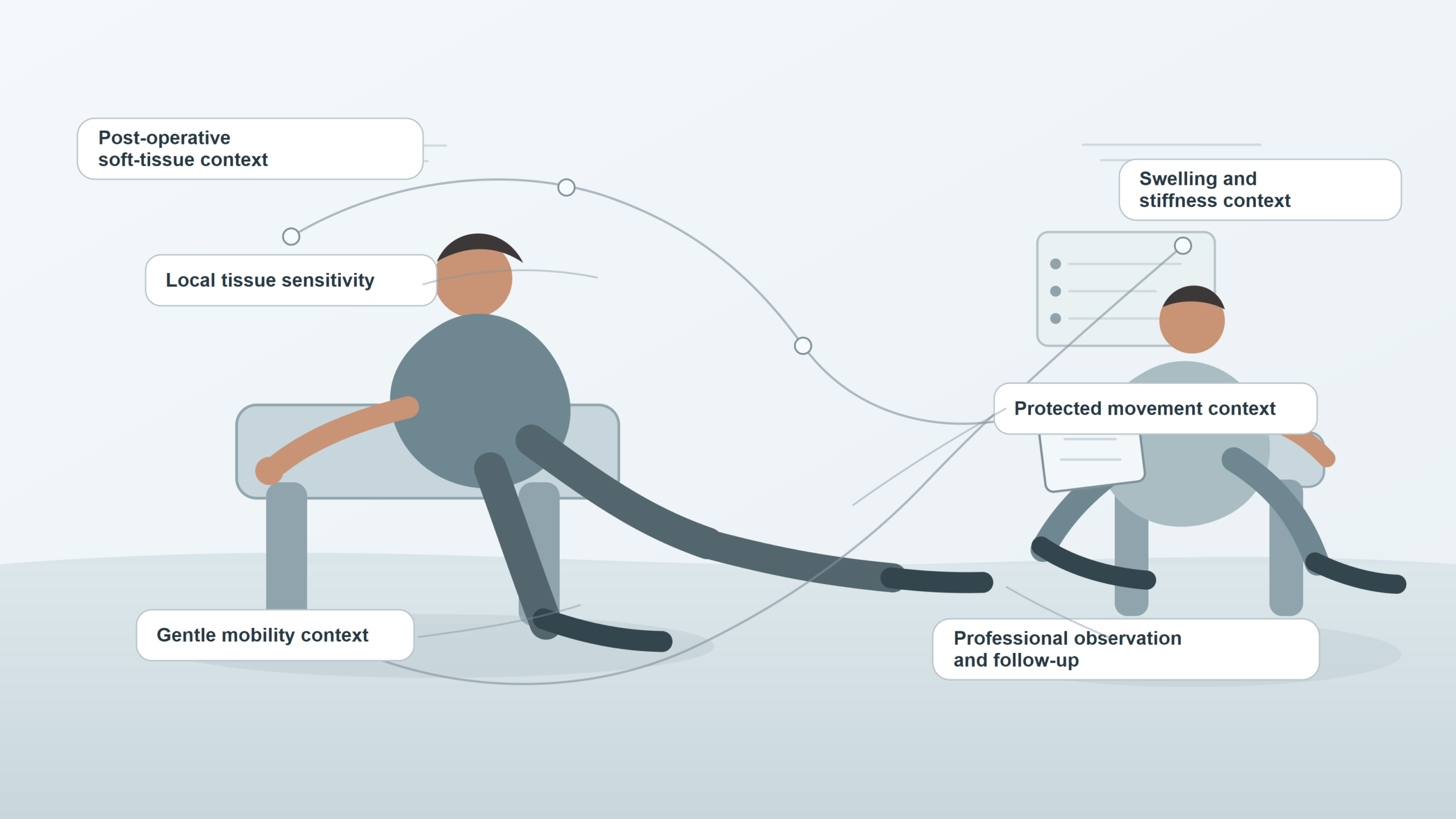
These questions help teams discuss post-operative support only after professional clearance and within documented service boundaries.
Procedure type, professional clearance, restrictions, skin or incision boundary, positioning limits, and escalation route must be documented.
Different staff may observe comfort, swelling, positioning tolerance and restrictions differently unless the record uses shared fields.
Record site, position, restriction, local feedback, staff member, time, reason for stopping if applicable, and next review owner.
Only inside approved professional service boundaries, as an equipment-support and documentation topic, not as a recovery promise.
Related Guides
Resources
For: professional care-support and rehabilitation teams.
Purpose: clearance, restriction and handover documentation.
Use the request form to ask for available worksheets, checklists and review templates for institutional evaluation.
Resources are intended for institutional review, workflow discussion and professional education. They are not diagnostic tools, clinical instructions or guarantees of clinical outcomes.
Post-operative Wound Care Checklist and Nursing Documentation Context
Post operative wound care checklist planning in professional care environments often requires a structured record for incision appearance, dressing review, local skin condition, patient comfort feedback, staff handover, post operative wound assessment, and post acute wound observation notes.
A surgical wound care nursing documentation process helps teams keep observation records consistent across shifts. These records support workflow discussion and product-evaluation review; they are not diagnostic tools or treatment instructions.
References
- 1. World Health Organization. WHO Guidelines for Safe Surgery 2009: Safe Surgery Saves Lives. Source.
- 2. National Institute for Health and Care Excellence. NG180: Perioperative Care in Adults. Published 19 August 2020; updated July 2025. Source.
- 3. ERAS Society. Procedure-Specific Enhanced Recovery After Surgery Guidelines Repository. Accessed 17 July 2026. Source.
- 4. Hartel M, et al. Randomized clinical trial of the influence of local water-filtered infrared A irradiation on wound healing after abdominal surgery. British Journal of Surgery. 2006;93(8):952-960. PMID: 16845694. DOI: 10.1002/bjs.5429. PubMed.
- 5. Hoffmann G. Heat for wounds: water-filtered infrared-A (wIRA) for wound healing: a review. GMS German Medical Science. 2016;14:Doc08. PMID: 27408610. DOI: 10.3205/000235. Full text.