2026 Evidence-Informed Low Back Pain Workflow Guide
Education and exercise are in place. Why does sitting, work return or sleep fluctuation still reset the service plan?
Summary
Chronic low back pain creates workload when each flare forces the team to reinterpret the same story. Education, staying active and individualized exercise remain the conservative-care base. This guide connects stratification, real-life triggers, local-response records, bounded wIRA evidence and a cautious CYP8 workflow path.
1. Chronic Low Back Pain Requires the Right First Split
Evidence boundary: Published wIRA study observations are provided as technology-background context. They are not CYP8 brand-specific clinical evidence, treatment instructions, or a guarantee of wound healing, pain reduction, functional recovery, or any individual clinical outcome.
Low back pain affects the region between the lower rib margins and the buttock creases. Pain lasting longer than about 12 weeks is commonly treated as chronic.[1][3] It cannot be reduced to one posture, one movement or one tissue.
For institutions, the first task is to distinguish time course, functional impact, psychosocial barriers and escalation signals before building a repeatable plan.
2. Stratification Decides Who Continues and Who Escalates
The practical output of stratification is a service decision.
| Area | What to observe | Decision value |
|---|---|---|
| Time and change | Duration, recent worsening and pattern | Stable chronic state or new concern |
| Functional task | Sitting, standing, bending, walking, lifting and work return | Real training starting point |
| Psychosocial factors | Fear, avoidance, stress, sleep and confidence | Support intensity |
| Execution setting | Home exercise, work demands and record capacity | Whether the plan survives real life |
| Escalation signals | Trauma, neurological change or major functional decline | Pause and refer |
The purpose is not to over-medicalize the case. It is to prevent every visit from starting from zero.
3. The Facility Burden: Fluctuation That Cannot Be Reused
Chronic low back pain consumes staff time when sitting, lifting, sleep or work stress changes the feedback and the team has no comparable record. The same client may look stable in the facility but return after work with tightness, fear or reduced tolerance.
The burden is repeated explanation, adjustment and handover.
4. The Working Mechanism Chain
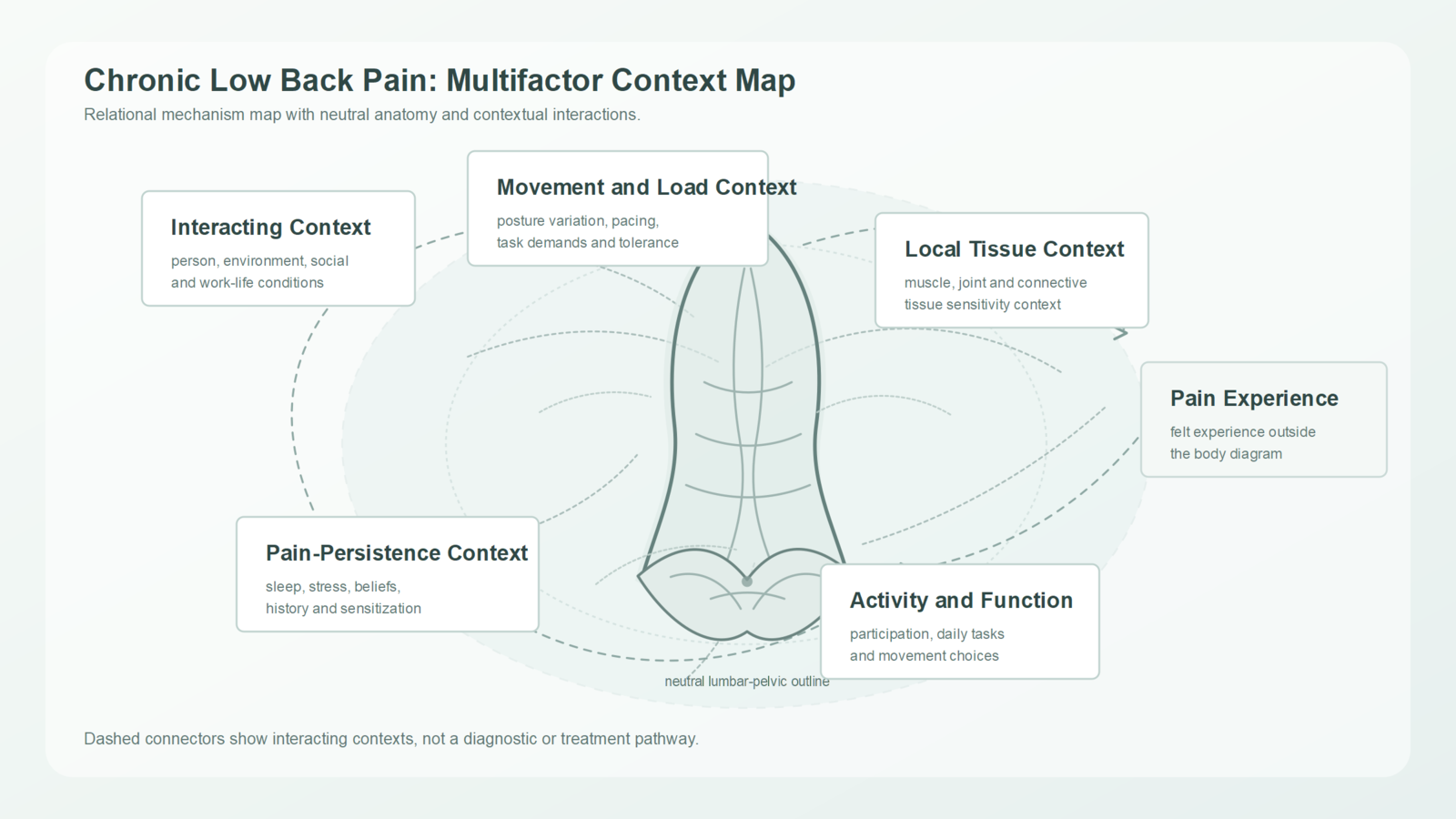
A practical workflow model is:
Real-life load, sitting, lifting, sleep and stress -> protective muscle response and movement guarding -> reduced training tolerance -> lower participation -> repeated reassessment, explanation and plan adjustment.
This is a service-planning model, not a diagnosis. It helps the team track why the plan fails outside the facility.
5. Conservative Care Remains the Foundation
WHO and NICE emphasize non-surgical management, individualized information, staying active, exercise and appropriate psychosocial support for chronic low back pain.[1][2][3]
| Pathway | Workflow role |
|---|---|
| Education and self-management | Creates a realistic recovery and activity framework |
| Staying active | Prevents unnecessary avoidance where appropriate |
| Exercise | Builds function through individualized progression |
| Work and activity adjustment | Connects the plan to real-life triggers |
| Psychosocial support | Addresses fear, confidence and adherence barriers |
| Referral | Handles signals outside the facility scope |
These pathways define the base. They do not automatically create a comparable record across real-life triggers.
6. The Remaining Gap: The Plan Is Correct, but Context Changes
A client may understand the need for movement but reduce activity after prolonged sitting. A facility session may go well, but work return or poor sleep may trigger protective tension. A short comfort improvement cannot prove durable participation.
The team needs to record four questions: what was the trigger, what was the pre-training state, what changed after support or exercise, and what requires pause or escalation?
7. Local Tissue-Environment Observation
A useful supplemental record may include local warmth sensation, protective muscle tension, comfort feedback, recovery after activity and training tolerance. These fields do not replace risk stratification, functional testing or professional assessment. They make repeated feedback comparable.
Only after this layer is present does it make sense to evaluate a non-contact photothermal support pathway.
8. wIRA Evidence: Back-Region Signal With Population Limits
Klemm et al. studied active axial spondyloarthritis, not chronic primary or nonspecific low back pain.[4] In that randomized study, a local continuous wIRA add-on was used during inpatient multimodal treatment, and pain NRS change favoured the intervention group.[4] The study did not show physiologically relevant serum cytokine changes.[4]
This is important but bounded: it is a specific inflammatory back-pain population and cannot be generalized to every chronic low back pain service.
Hoffmann’s wIRA mechanism review discusses tissue temperature, oxygen tension and perfusion-related observations in the broader wIRA literature.[5] This supports a local tissue-environment discussion, not a universal low-back-pain outcome claim.
9. How CYP8 Can Be Evaluated
CYP8 may be evaluated as a recordable support step inside the existing rehabilitation plan.
| Stage | Action | Minimum record |
|---|---|---|
| Suitability and boundary | Confirm case type, escalation signals and professional permission | Reviewer, restrictions and stop criteria |
| Baseline | Record trigger context, function task, comfort and protective tension | Baseline and activity context |
| Equipment session | Follow product instructions and facility SOP | Operator, setting, distance, time and feedback |
| Exercise link | Compare readiness and activity tolerance | Completed task, load and adjustment |
| Handover | Decide continue, pause, adjust or refer | Owner, next action and review time |
CYP8 should not be used to replace education, exercise, medical review or escalation.
10. Next Step
Add four fields to the low back pain record: real-life trigger, pre-training state, post-training feedback and stop/escalation signal. After one review cycle, the team can identify which fluctuations lack comparable information.
For the current availability of the low back pain workflow sheet, contact the CYP8 team. No public download is promised on this page.
More information: wIRA technology | CYP8 product evaluation | Institutional contact
Common Questions About Low Back Pain
These questions help teams organize activity observation and support-workflow notes in a professional institutional context.
Record activity context, posture or load concern, comfort feedback, work or care setting, support already used, and next review owner.
Pain descriptions, activity limits, staff observations and follow-up actions are often recorded in separate places.
It should connect task, activity limit, local feedback, environmental factor, support action and next review timing.
Only as a professional product-evaluation and documentation topic, not as personal medical advice or an outcome claim.
Related Guides
Resources
For: rehabilitation teams and facility reviewers.
Purpose: activity-context notes and structured follow-up discussion.
Use the request form to ask for available worksheets, checklists and review templates for institutional evaluation.
Resources are intended for institutional review, workflow discussion and professional education. They are not diagnostic tools, clinical instructions or guarantees of clinical outcomes.
Chronic Low Back Pain Care Plan and Workflow Review
In long-term care, professional nursing, and rehabilitation-support settings, chronic low back pain care plan and chronic low back pain nursing care discussions often include activity tolerance, mobility notes, comfort feedback, staff-supervised routines, and back pain care workflow documentation.
Low back pain functional assessment remains part of professional review. CYP8-related documentation should be used to support observation and product-evaluation discussions, not to replace specialist assessment or claim a treatment outcome.
References
- 1. World Health Organization. Low back pain fact sheet. 19 June 2023. https://www.who.int/news-room/fact-sheets/detail/low-back-pain
- 2. World Health Organization. WHO guideline for non-surgical management of chronic primary low back pain in adults. 2023. https://www.who.int/publications/i/item/9789240081789
- 3. NICE. Low back pain and sciatica in over 16s: assessment and management (NG59). https://www.nice.org.uk/guidance/ng59
- 4. Klemm P, et al. Treatment of back pain in active axial spondyloarthritis with serial locoregional wIRA. J Back Musculoskelet Rehabil. 2022;35(2):271-278. PMID: 34602460.
- 5. Hoffmann G. Principles and working mechanisms of wIRA. PMID: 20204085.