2026 Evidence-Informed Knee OA Mobility Support Workflow Guide
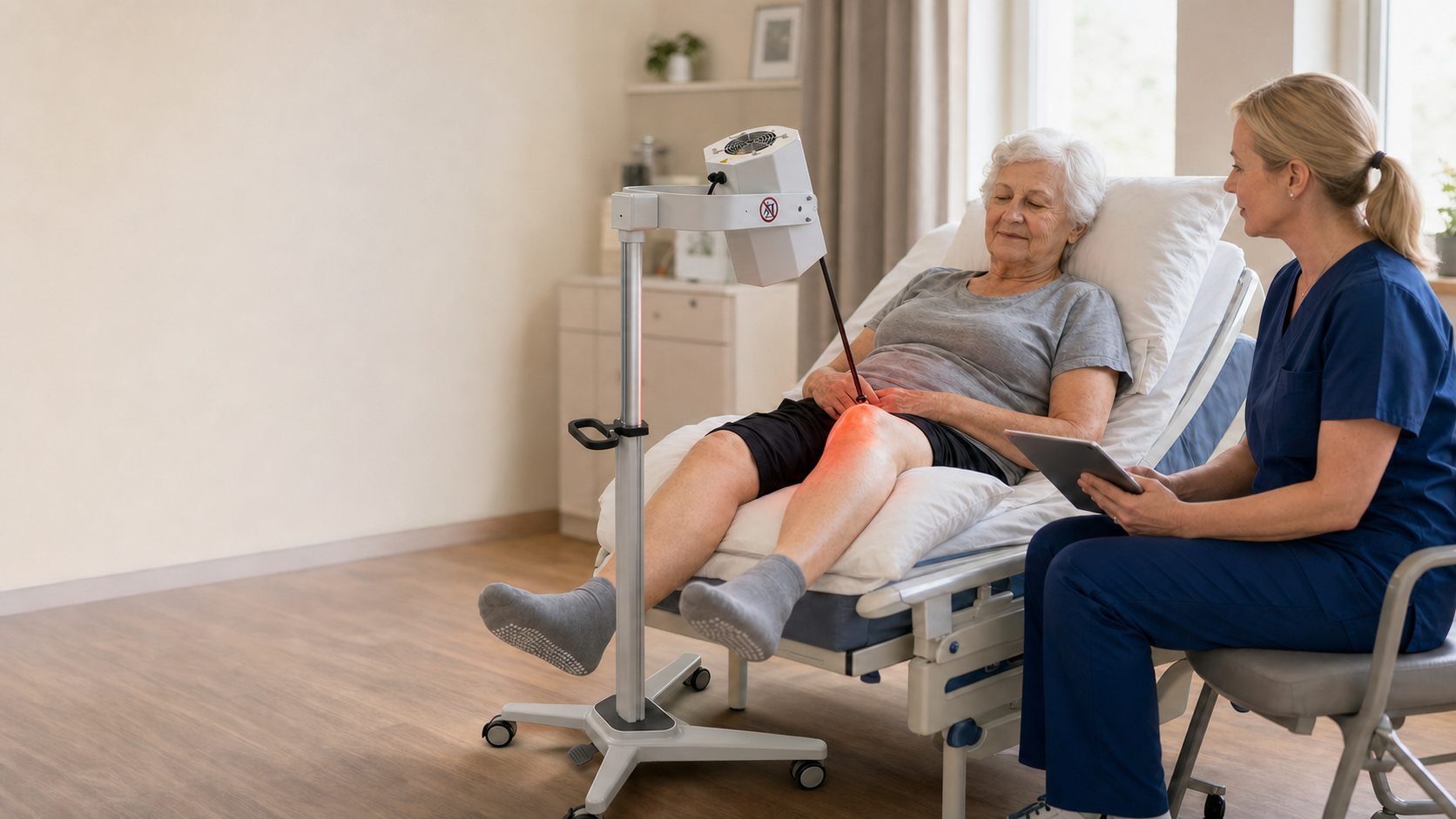
Exercise is prescribed, but why do stiffness, tension and fluctuating tolerance still interrupt training?
Summary
Knee OA workflow problems are not only about exercise selection; they are about keeping training tolerable, comparable and reviewable. Education, exercise and load management remain the conservative-care foundation. This guide connects functional stratification, service burden, adjacent wIRA evidence and a cautious CYP8 workflow evaluation path.
1. Knee OA Management Starts With Function
Evidence boundary: Published wIRA study observations are provided as technology-background context. They are not CYP8 brand-specific clinical evidence, treatment instructions, or a guarantee of wound healing, pain reduction, functional recovery, or any individual clinical outcome.
Knee osteoarthritis should be managed through function, symptoms, activity tolerance and shared decision-making, not imaging alone.[1] A static image cannot tell a facility whether a person can walk, climb stairs, tolerate loading or continue a home programme.
The institutional question is: can the team record training readiness, local feedback and next adjustment in the same language each time?
2. Functional Stratification Answers “Where Do We Start Today?”
Effective stratification sets the starting point, supervision level and review rhythm.
| Dimension | What to observe | Why it matters |
|---|---|---|
| Mobility task | Walking, stairs, sit-to-stand and range | Defines the real training target |
| Load tolerance | Standing time, body-weight load and post-activity feedback | Sets exercise dose |
| Muscle control | Quadriceps, hip control, balance and compensation | Directs movement quality |
| Comfort feedback | Stiffness, tightness, heat sensation and fatigue | Determines preparation and review |
| Escalation signs | Rapid worsening, swelling, trauma or major function decline | Triggers professional review |
The goal is not to label the client. The goal is to decide what can be done safely and consistently today.
3. The Facility Burden Is Repeated Adjustment
Knee OA services consume time when assessment, explanation, dose adjustment and handover repeat without a stable record. One week the client reports stiffness; the next week the issue is fear, fatigue or tolerance after activity. If each staff member uses different language, the team loses the baseline.
The workload is not the number of exercises. It is rebuilding the context every session.
4. The Working Mechanism Chain
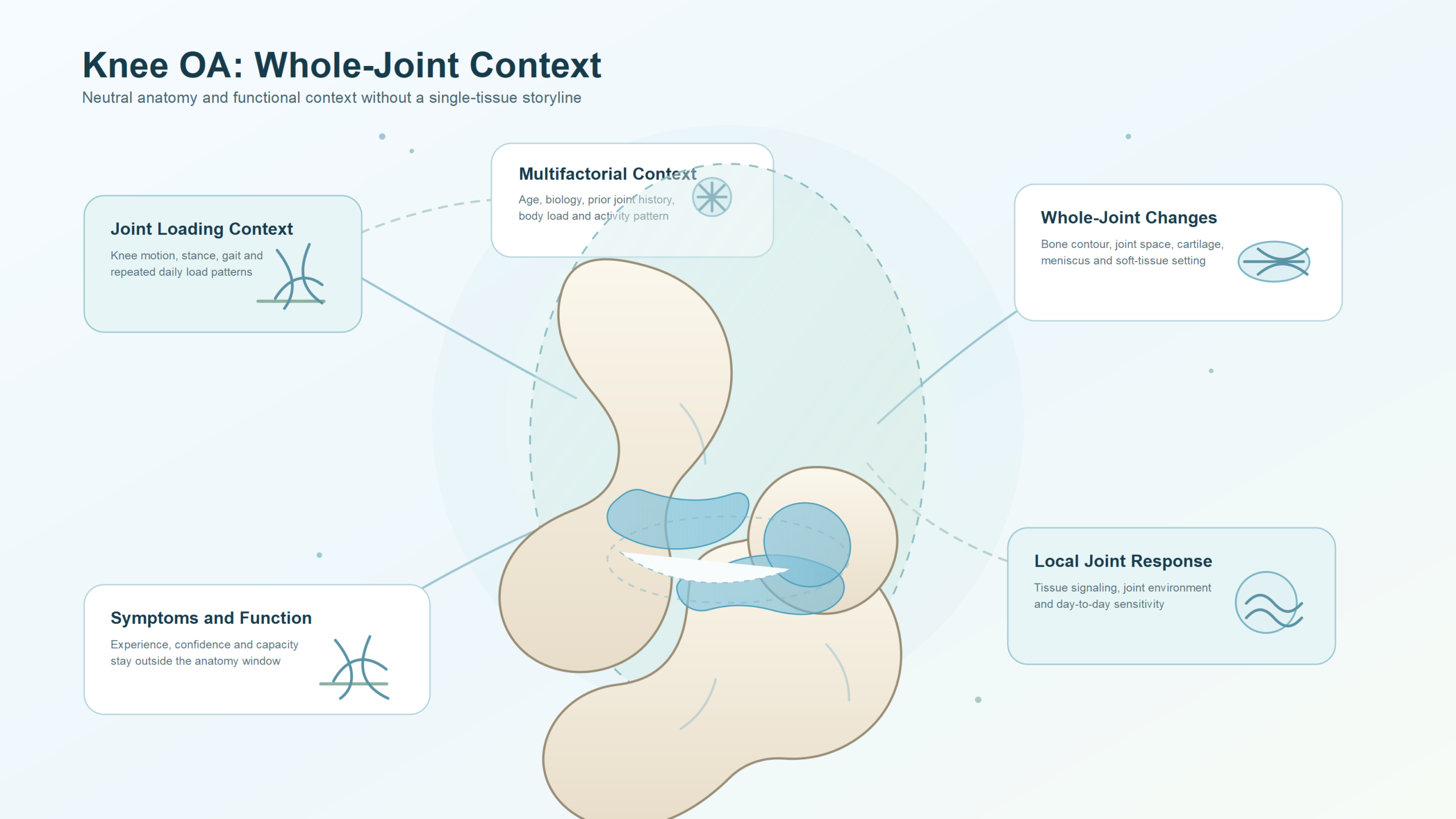
A practical service model is:
Joint load and structural change -> local feedback and altered movement control -> protective tension and compensation -> lower movement quality -> interrupted training -> repeated reassessment and service handover.
This model does not diagnose the cause of pain. It helps the team connect local feedback, training readiness and operational workload.
5. Conservative Care Remains the Base
Guidelines support education, structured land-based exercise, weight management where relevant, self-management and appropriate clinical review as central non-surgical OA strategies.[1][2][3]
| Pathway | Workflow value |
|---|---|
| Education | Builds realistic expectations and long-term self-management |
| Exercise | Improves function through progressive, individualized movement |
| Load and weight management | Reduces stress and supports participation where relevant |
| Assistive support | Helps selected clients continue activity |
| Medical review and referral | Manages red flags and care beyond facility scope |
These pathways define what should be done. They do not automatically make every session comparable.
6. The Remaining Gap: The Plan Is Correct, but Readiness Fluctuates
Facilities often have the right exercise plan but still lose continuity because pre-training state, local comfort feedback and post-training response are not recorded in a consistent way.
Exercise answers what to do. Dose adjustment answers how much. Education answers why it matters. The missing layer is a repeatable record of readiness and response.
7. Local Tissue-Environment Observation
A useful supplemental record may include local temperature sensation, protective muscle tension, comfort feedback, post-activity recovery speed and exercise tolerance. These fields do not replace functional testing or professional assessment. They help the team decide whether the next session needs more preparation, lower load, different pacing or escalation.
Once this observation layer exists, a non-contact photothermal support pathway can be evaluated as part of workflow support rather than as a stand-alone treatment claim.
8. wIRA Evidence: Adjacent, Not Knee-OA-Specific
No knee-OA-specific wIRA clinical trial is established for this page. The available evidence used here is adjacent musculoskeletal and mechanism information.
| Evidence | What it can support | What it cannot support |
|---|---|---|
| Klemm et al., 2022 RCT in active axial spondyloarthritis | Short-term adjacent signal in a different inflammatory back-pain population; pain NRS change was reported[4] | Not knee OA evidence and not CYP8 brand proof |
| Hoffmann mechanism review | Human tissue-temperature, oxygen tension and perfusion-related discussion for wIRA[5] | Not a knee OA outcome study |
The allowed conclusion is limited: wIRA is relevant to a local tissue-environment discussion. It should not be described as improving knee OA structure, pain, function or long-term outcomes unless direct evidence is available.
9. How CYP8 Can Be Evaluated
CYP8 may be evaluated as a recordable support step inside an existing conservative-care workflow.
| Stage | Responsible action | Minimum record |
|---|---|---|
| Suitability and boundary | Confirm scope, contraindications and escalation signals | Reviewer, restrictions, allowed use |
| Baseline | Record task, comfort feedback, protective tension and skin status | Site, activity context and baseline |
| Equipment session | Follow product instructions and facility SOP | Operator, setting, distance, time and feedback |
| Training link | Compare readiness with training quality | Exercise completion, load and adjustment |
| Handover | Decide continue, pause, adjust or refer | Next action, owner and review date |
The value question is whether records become more consistent and training decisions become easier to review.
10. Next Step
Add four fields to the current knee OA record: pre-training state, post-training feedback, escalation signal and review time. After one review cycle, the team can decide whether a supplemental support pathway deserves evaluation.
For the current availability of the knee OA mobility workflow sheet, contact the CYP8 team. No public download is promised on this page.
More information: wIRA technology | CYP8 product evaluation | Institutional contact
Common Questions About Knee OA
These questions help institutional teams organize mobility observation, comfort feedback and review notes without turning the page into personal medical advice.
Record activity context, mobility limitation, comfort feedback, assistive-device use, staff observation, and the next review point.
Different staff may record symptoms, function and activity context separately, making trend review harder for the next reviewer.
A useful record connects activity, observed limitation, environment, support already used, and follow-up responsibility.
Only as a professional product-evaluation topic within facility workflow discussion, not as a promise of symptom or outcome change.
Related Guides
Resources
For: rehabilitation and care-support teams.
Purpose: mobility, activity context and review-note consistency.
Use the request form to ask for available worksheets, checklists and review templates for institutional evaluation.
Resources are intended for institutional review, workflow discussion and professional education. They are not diagnostic tools, clinical instructions or guarantees of clinical outcomes.
References
- 1. NICE. Osteoarthritis in over 16s: diagnosis and management (NG226). https://www.nice.org.uk/guidance/ng226
- 2. Bannuru RR, et al. OARSI guidelines for non-surgical management of osteoarthritis. Osteoarthritis Cartilage. 2019;27(11):1578-1589. PMID: 31278997.
- 3. Kolasinski SL, et al. 2019 ACR/Arthritis Foundation Guideline for Osteoarthritis. Arthritis Care Res. 2020;72(2):149-162.
- 4. Klemm P, et al. Treatment of back pain in active axial spondyloarthritis with serial locoregional wIRA. J Back Musculoskelet Rehabil. 2022;35(2):271-278. PMID: 34602460.
- 5. Hoffmann G. Principles and working mechanisms of wIRA. GMS Krankenhhyg Interdiszip. PMID: 20204085.
route questions
Knee OA Mobility Documentation Questions
Which daily activities are commonly affected in Knee OA mobility review?
Knee OA mobility review often needs notes on walking, stairs, standing from a chair, transfers, standing tolerance, kneeling, squatting, and participation in routine activities.
| Activity | Documentation angle | Boundary |
|---|---|---|
| Walking | Distance, pace, pauses, support needed | Not treatment outcome |
| Stairs | Up/down difficulty, rail use, assistance | Not rehabilitation prescription |
| Transfers | Chair, bed, vehicle, toilet transfer difficulty | Not clinical assessment |
| Participation | Work, home tasks, recreation, appointments | Not symptom-cure claim |
This FAQ supports activity-context documentation for professional review. It does not claim that CYP8 improves Knee OA symptoms, mobility, or imaging findings.
How should stiffness, walking tolerance, and stair difficulty be documented for Knee OA?
Stiffness, walking tolerance, and stair difficulty should be documented as activity-impact observations over time, not as proof of treatment response.
| Field | Example note | Boundary |
|---|---|---|
| Stiffness | Morning stiffness, after sitting, after activity | Not diagnosis |
| Walking tolerance | Distance, time, pauses, support needed | Not outcome promise |
| Stairs | Number of steps, rail use, assistance, avoidance | Not exercise plan |
| Review trend | Better, same, worse, or fluctuating as reported or observed | Not CYP8-specific effect |
This FAQ should be used as mobility documentation support. It should not replace an osteoarthritis management plan or professional review.